
Bees in My Wall — What to Do (and What Not to Do)
By Justin Jacobeen — Certified Master Beekeeper, Been’s Bees · May 4, 2026
If you’re reading this with bees flying in and out of your wall — you’ve got time. A wall colony has been there at least a few weeks, often longer. A few hours one way or the other won’t change anything, but the next move matters.
Is it actually honeybees?
Three insects routinely get mistaken for honeybees, and the response is different for each:
- Honeybees — fuzzy, golden-brown with darker bands, about half an inch long, calm flyers. They build wax comb inside a cavity. This is what we handle.
- Yellow-jackets and hornets — slick, smooth, brighter yellow stripes, more aggressive flight. They build paper nests. Call a licensed exterminator.
- Carpenter bees — large solitary bees that bore perfect-circle holes in wood eaves and trim. Different problem — carpenter-bee specialists or pest companies handle these.
If you can take a photo safely, text it to (717) 583-8332. We’ll usually identify the species in a few seconds.
What to do right now
- Watch them for five minutes from a safe distance. Are they flying in and out of one specific spot? That’s a colony. Note where exactly — siding gap, soffit vent, weep hole, knot in trim.
- Take a photo of the entry point, the surrounding area, and the bees themselves if you can do it safely.
- Don’t disturb the entry. No spraying, no plugging, no covering with tape.
- Call or text us at (717) 583-8332. Send the photo. We’ll schedule a free on-site estimate.
- In the meantime, keep pets and small kids away from the entry zone.
What NOT to do
- Don’t spray anything into the cavity. Bug spray, hornet spray, ammonia, soap — none of it works, and several make things much worse. A poisoned colony left in a wall means tens of thousands of dead bees rotting in the cavity, abandoned honeycomb that attracts ants and wax moths, honey leaking through drywall for months, and an empty cavity that becomes a beacon for next spring’s swarm.
- Don’t plug or seal the entry. A blocked entry traps the colony — they’ll find another way out, often through interior drywall, vents, or electrical outlets. We’ve seen homeowners wake up to bees inside the bedroom because the entry got caulked the night before.
- Don’t light a fire in a chimney to flush them. It kills the colony, melts wax into the flue, and creates a mess that requires a chimney sweep and a beekeeper to clean up.
- Don’t try a DIY extraction unless you’re a hobbyist beekeeper with the gear — and even then, call us first. A wall colony usually contains 20,000–40,000 bees and 10–40 pounds of comb.
What a real live removal looks like
A recent job from a Central PA bedroom. The homeowner heard buzzing in the wall but couldn’t see anything from outside or inside.
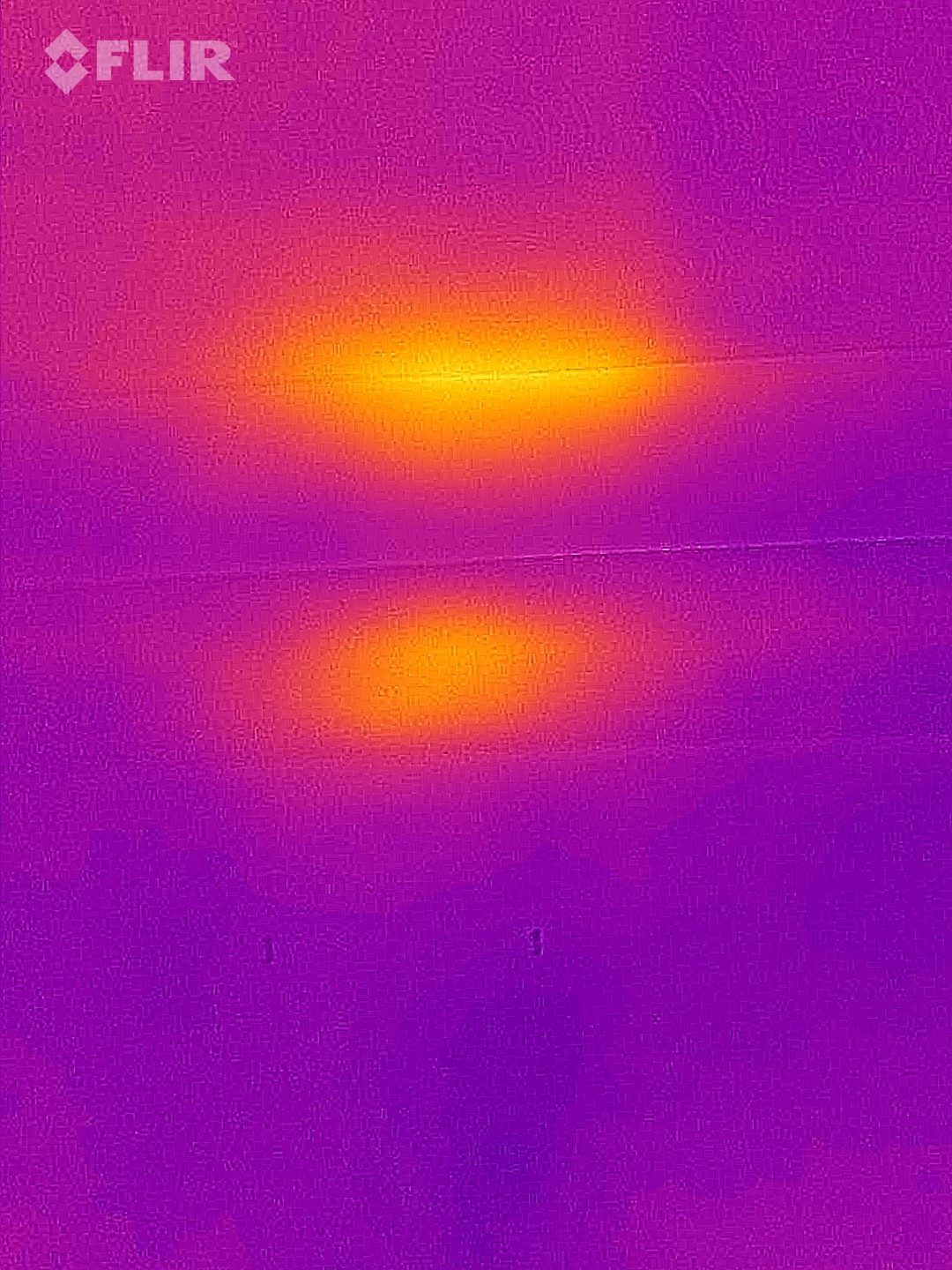 Thermal scan. The two bright orange signatures are the brood nest, kept at 95°F by the bees, glowing through the drywall.
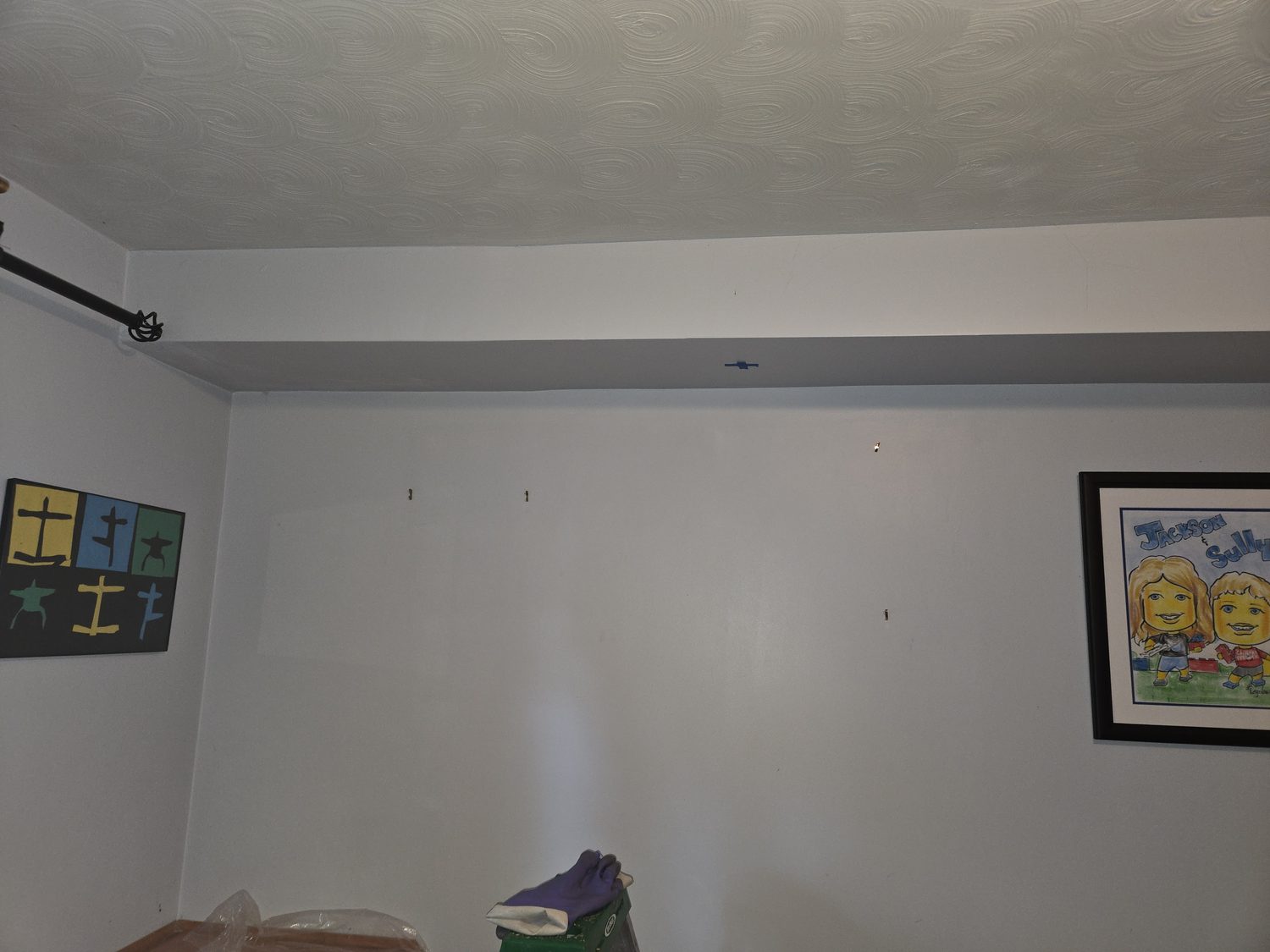 What the homeowner saw. No stains, no entry point indoors. The bees were entering through a small gap in the exterior siding around the corner.
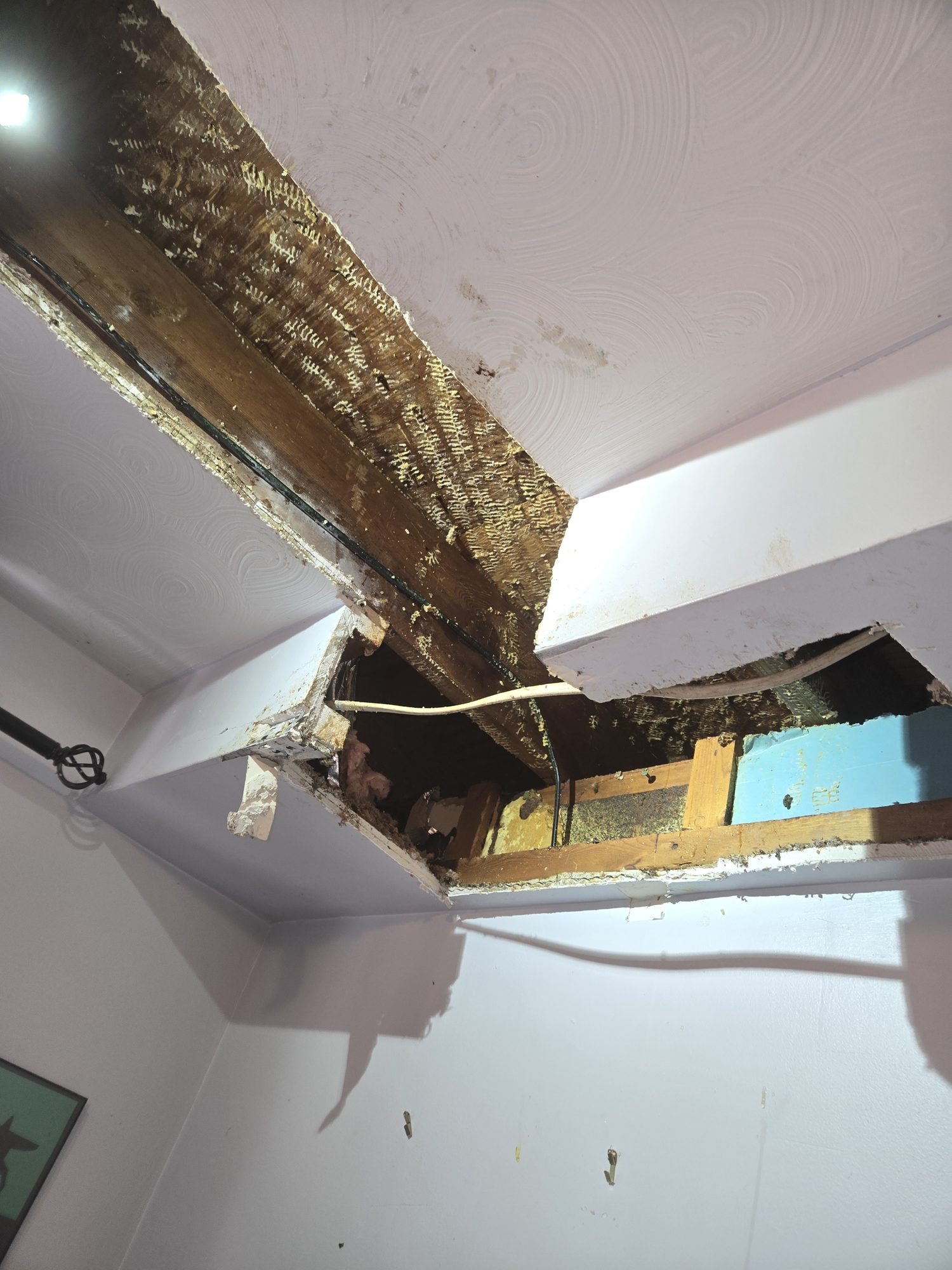
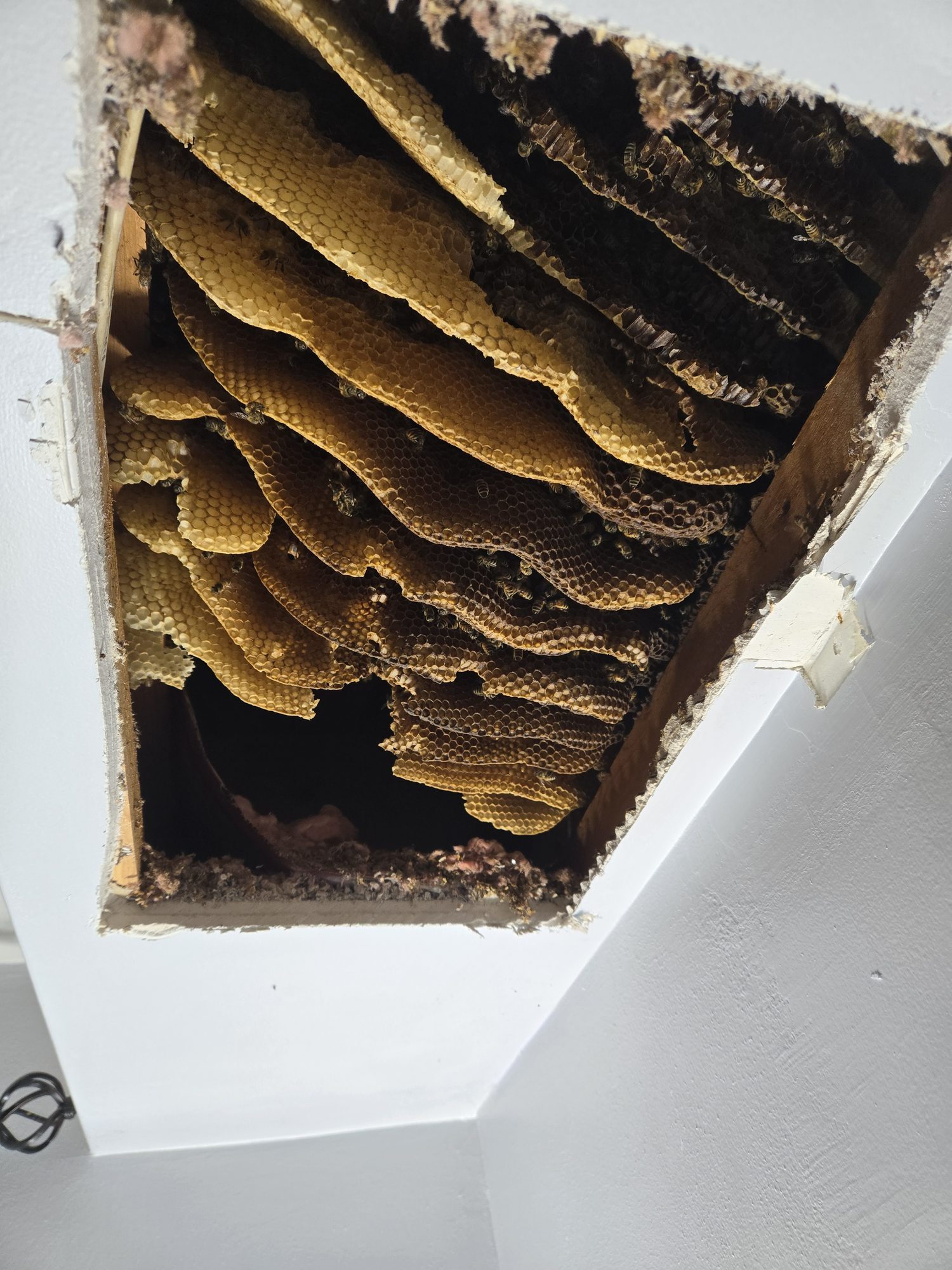 Drywall opened. Dense parallel comb sheets full of brood and capped honey, exactly where the thermal pointed.
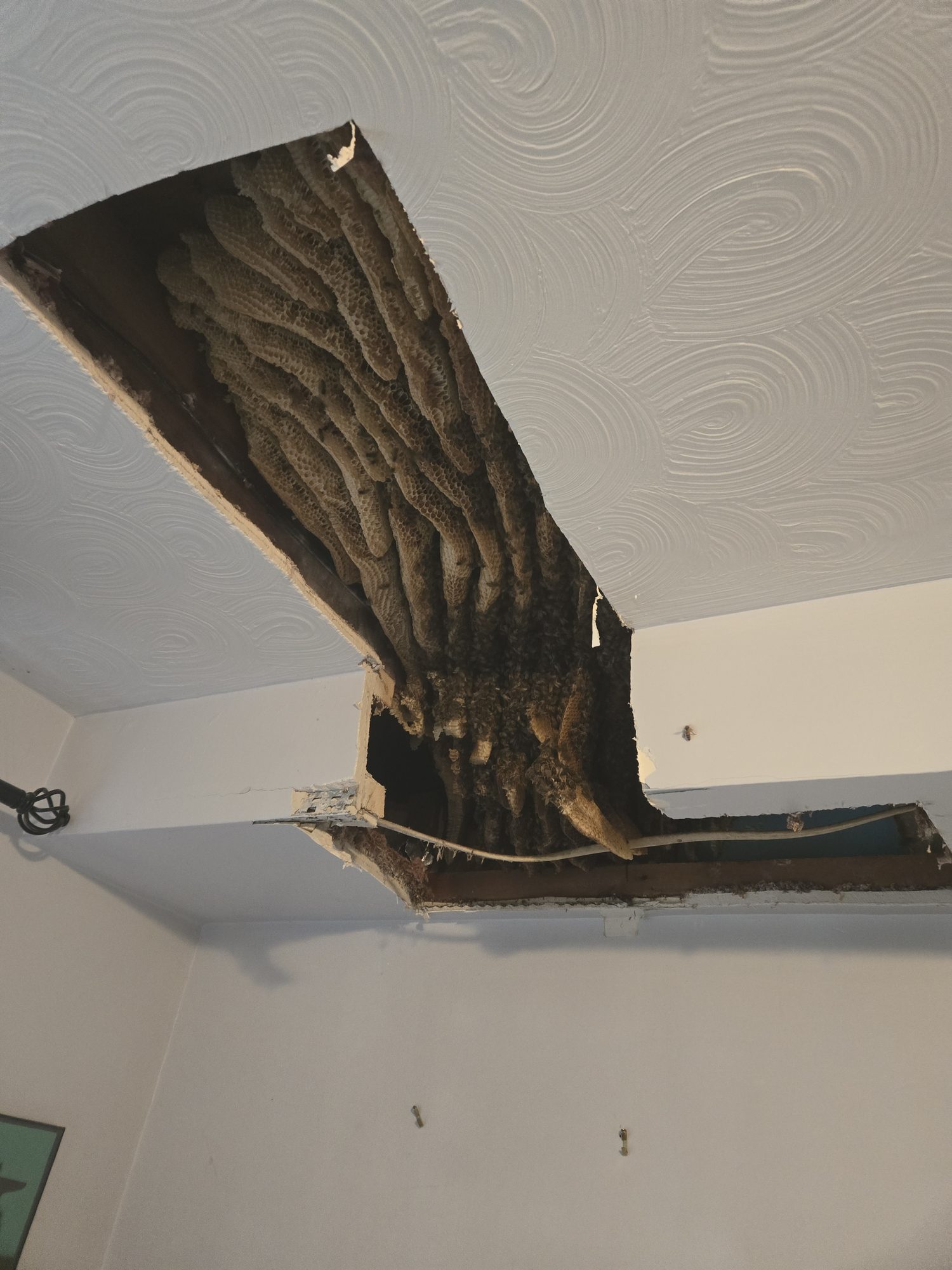 Full extent. The colony ran around the corner into the ceiling, forming an L-shape across two cavities — about 35 pounds of comb total.
 Cavity cleaned. Bees en route to one of our apiaries, comb saved in transport frames, wall sealed temporarily until the homeowner’s contractor finished the patch.
A moderate-tier job, about 5 hours of on-site work. The full process — thermal location, interior or exterior approach, live vacuum extraction, brood-comb salvage, cavity sealing — is laid out on our removal page.
What it costs
| Job type | Typical price | What it covers |
|---|---|---|
| Standard | $650 | Accessible from a stool or stepladder — one-story soffits, low porch eaves, ground-level wall openings |
| Moderate | $750 – $1,000 | Ladders or scaffolding required — second-story walls, taller chimneys, deeper masonry row-homes |
| Complex | $1,200+ | Bucket lift required — tall Victorian roofs, hard-access chimneys, multi-story complications |
Free on-site estimate before any paid work. No deposit, no commitment. Deeper cost breakdown at the pricing article.
After we’re done, the cavity is sealed exterior-side and covered with plastic sheeting interior-side. The drywall or siding patch is a separate job for a handyman — usually a few hundred dollars depending on what was opened.
Ready to get the bees out?
Call or text (717) 583-8332 with a photo and the location of the colony. Free on-site estimate, no pressure, no upsell.
Call or text Been’s Bees at (717) 583-8332 — live honeybee removal, free swarm collection, bees, and raw local honey across Central PA.